1.1. Project Background
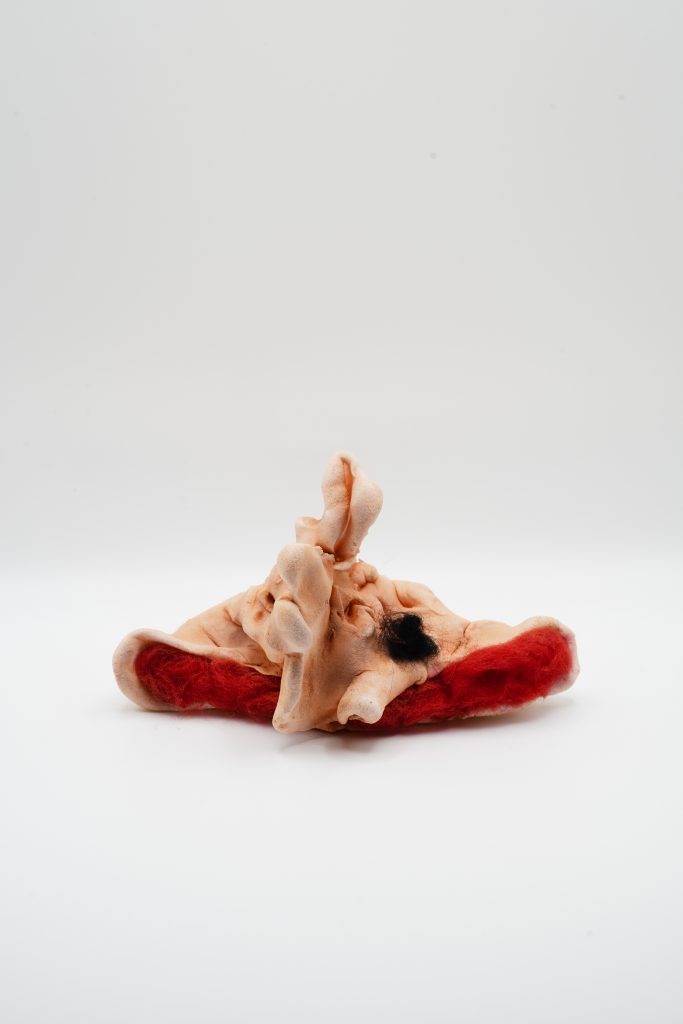
This project originated from reflections on the lack of family identity among contemporary youth and the underlying socio-cultural structures. With the acceleration of globalization, urbanization, and digitalization, unmarried and childless young adults aged 18-24 are gradually distancing themselves from traditional family structures, creating complex tensions between familial influence and personal choices. Through workshops, interviews, and artistic creation, this project collects and presents their narratives, emotions, conflicts, and fantasies surrounding “home.” Fragmented memories are reconstructed through sculpture and text, ultimately generating an artistic system of “fictional family histories.”
2.1. Core Concepts
Displaced Narratives: Memories of reality intertwine with fictional family histories, creating uncertainty and imaginative space, revealing the dual role of family within emotional bonds and social norms.
Participatory Creation: Sculptures and sound archives stem from genuine group participation, endowing the work with sociological and emotional depth.
Multimedia Integration: Combining sculpture, text, sound, and spatial installations to create an immersive viewing experience.
Healing and Reflection: The exhibition and book are not the endpoint of exposing contradictions, but rather the starting point for building dialogue. They provide a safe space for audiences to reconsider the meaning of family within self-identity.
3.1. Book Design
Using a first-person perspective, it weaves together the memories and aspirations of all interviewees, forming a “perfect family history” that is both authentic and fictional. The narrative style leans toward a collage of fragmented memories and family archives, incorporating visual elements such as photographs, sculptural images, interview excerpts, fictional letters, and family record forms.
Design Reference: A Living Man Declared Dead and Other Chapters
The narrative adopts a chapter-based structure, comprising approximately six chapters. Using sculptures and interviews as its foundation, it depicts the “perfect family” as envisioned by them through the eyes of a Chinese child.
The book encompasses both its darker aspects (trauma, conflict) and brighter moments (shared heartwarming scenes, imagined beautiful times). From the first half revealing the cracks and shortcomings within the family to the fantasy of a utopian family, it guides readers from resonance to finding warmth.
3.1.1 Chapter Design
Chapter One: The Dining Table
Theme:
The dining table as a symbol of “reunion,” embodying both warm scenes and memories of arguments.
Text:
Combining descriptions from multiple interviewees, a fictional family dinner scene unfolds, interwoven with “my” memories and imaginings.
Bright Side:
Everyone making dumplings together, laughter, clinking glasses.
Dark Side:
Silence beneath the table, parental arguments, elders’ biases.
Visuals:
Close-ups of the dining table, sculptural works (tables and chairs), scanned handwritten recipes.
Chapter Two: The Window
Theme:
The window symbolizes “the boundary between the outside world and the inner self,” reflecting the psychological desire to escape or to watch over.
Text:
Describes the narrator as a child, leaning against the window watching rain, fantasizing about another life, while incorporating interview excerpts about “wanting to leave home.”
Bright Side:
Viewing festive lights and the hope of the outside world through the window.
Dark Side:
Beyond the window lies solitude; mist on the glass reflects the cold, empty room.
Visuals:
Window photographs, sculpted window frames, handwritten diary pages.
Chapter Three: The Bed
Theme:
The bed serves as a dual symbol of secrecy and safety, evoking childhood security, adolescent privacy, and solitude.
Text:
“My secrets, and the secrets I witnessed within my family.” This section functions as a soothing interlude, offering a moment of respite.
Visuals:
Crumpled sheets, the soft glow of a nightlight, sculptural photographs.
Chapter Four: The Bookshelf
Theme:
The interplay of knowledge, discipline, and individual freedom.
Text:
“My father’s library stood like a wall, and I always wanted to tear it down.”
Visual:
Opened pages, torn notes.
Chapter Five: The Absent Ones
Theme:
Absent fathers, distant mothers, grandparents never met.
Narrative Technique:
Conveying emptiness through fictional letters and family tree archives.
Bright Side:
“I” crafts perfect personalities for these absent figures in my mind.
Dark Side:
“I know these are lies, but at least they make me feel warm.”
Visuals:
Pages dominated by blank space, empty frames meant for pasted family photos.
Chapter Six: We Are Family
Theme:
Rebuilding a safe home through imagination.
Content:
“I” envision what our life would be like if all conflicts were resolved.
Tone:
Lighthearted and poetic, creating an emotional outlet for readers.
Visuals:
Color photography, collages of warm scenes, sculptures arranged to form the shape of a “home.”
Final Chapter: Family Tree
Format:
A wholly fictional family tree, filled with the interviewee’s pain and fantasies.
Visual:
Dense text throughout, yet leaving the second page blank to welcome readers’ reflections.
3.2. Exhibition Design
(AI Generation)
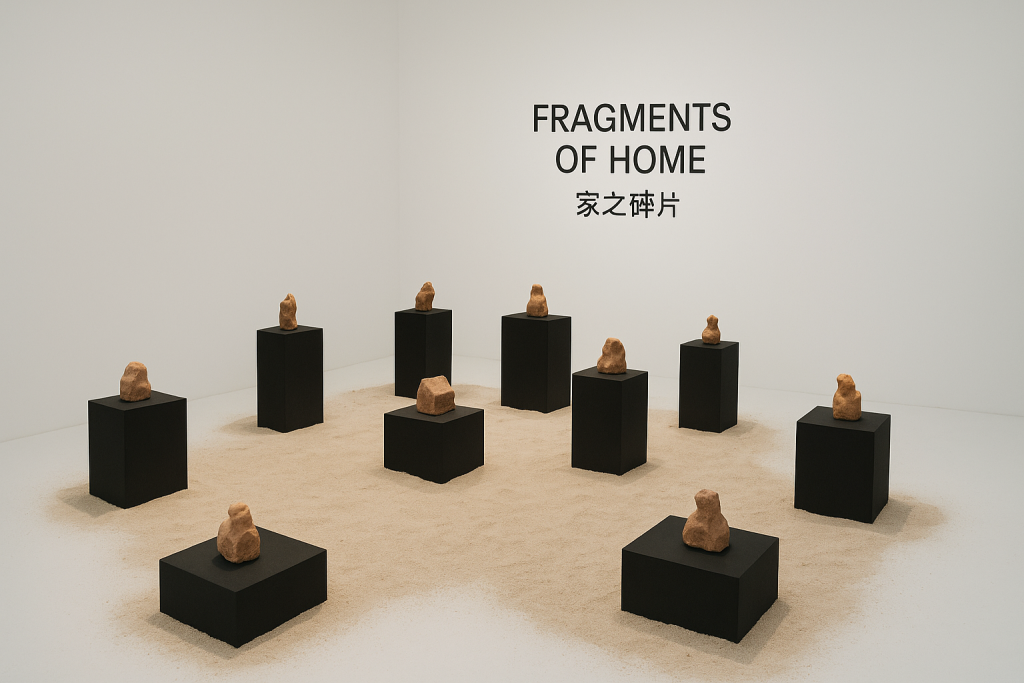
The sculptures are displayed on platforms of varying heights, with the ground covered in fine sand to create an overall “island” effect. Viewers can observe the installation from a distance, perceiving the sculptures as a unified “home,” or approach each piece for closer inspection. A speaker in the central area plays recordings of the interviewees, while the sides of the platforms feature subtitles in both Chinese and English.
Leave a Reply