This is the final round of testing for this project. I tested different groups of people and gathered their experiences after playing. Since the project is being promoted in China, anonymity and impartiality of responses were ensured. (No one knew the researcher.)
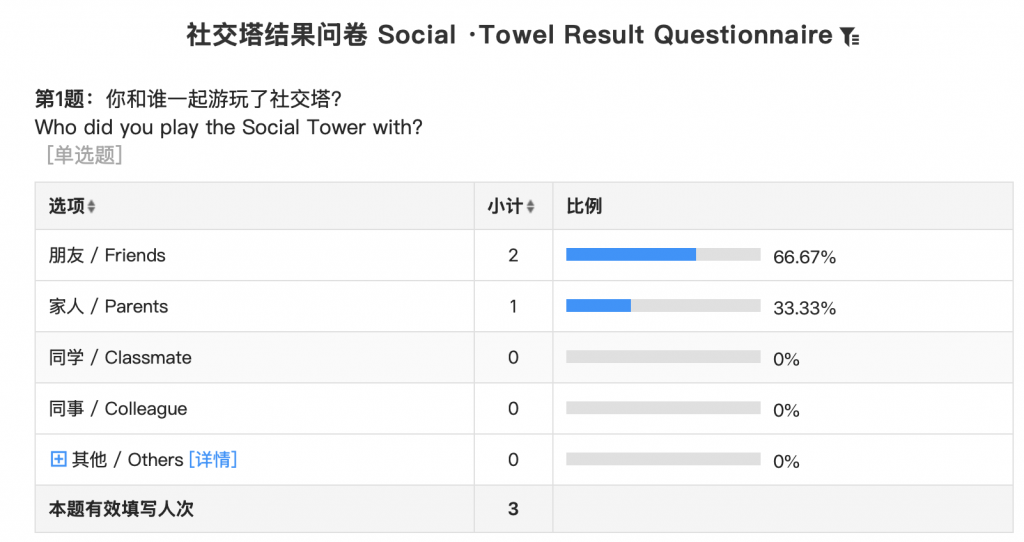
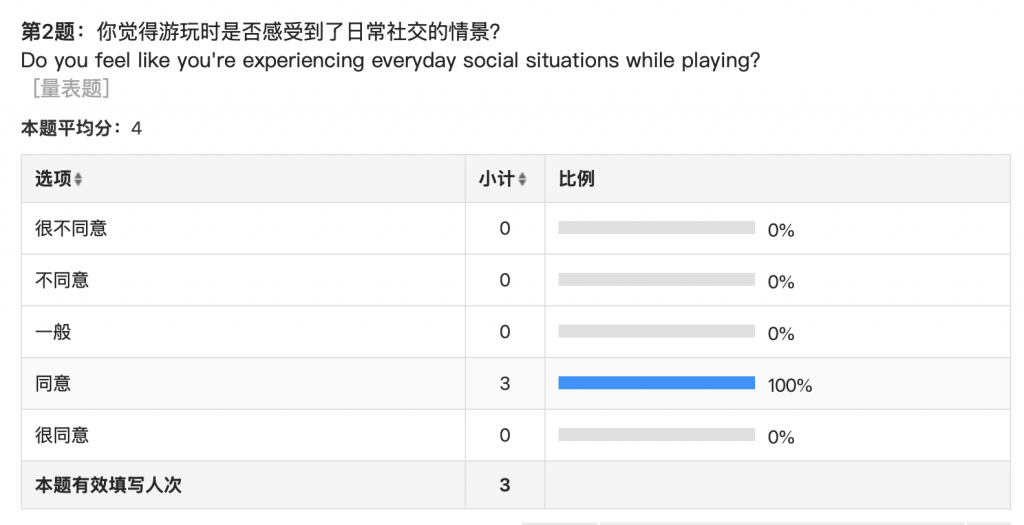
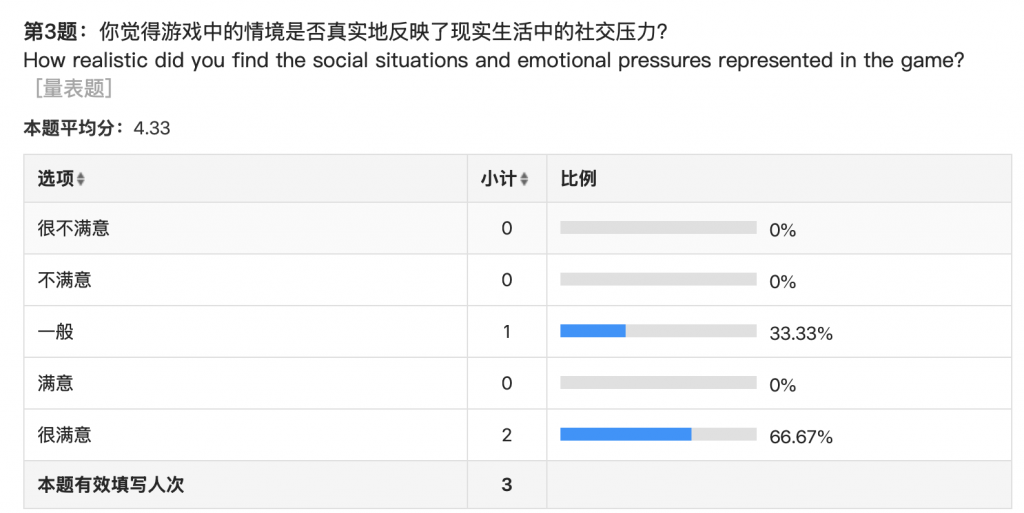
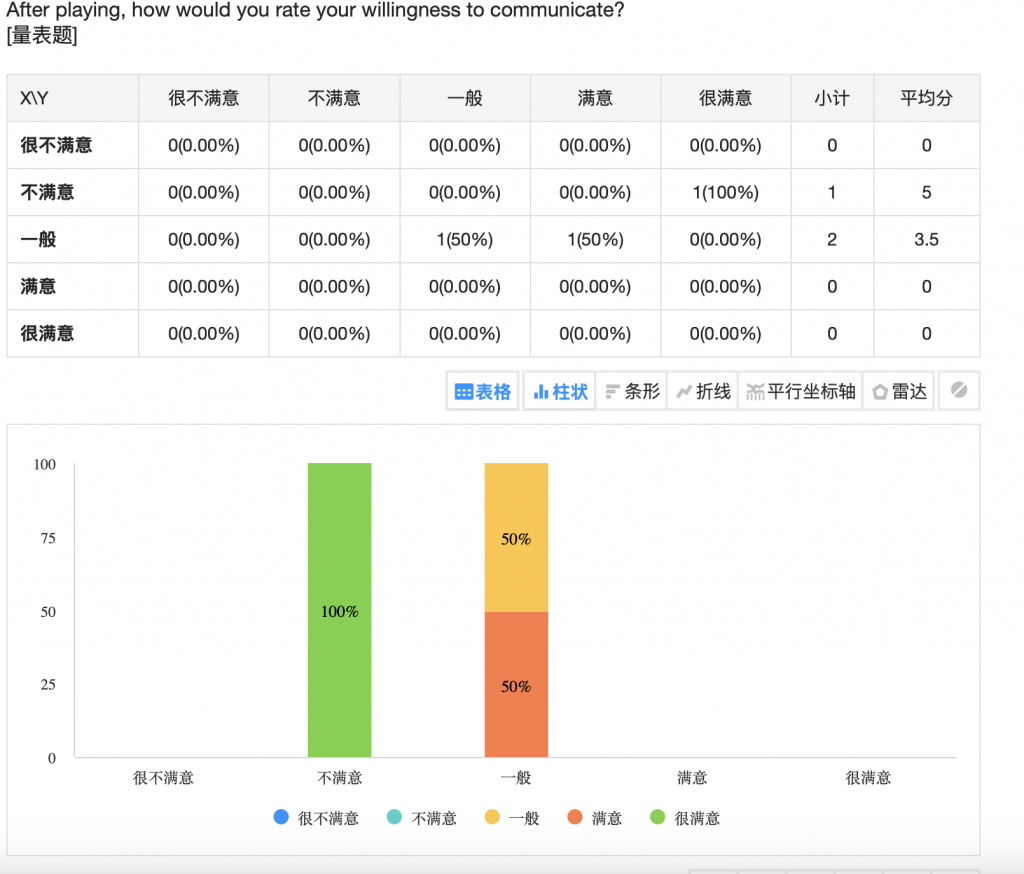
After the playing, most participants showed an increased willingness to communicate with others.
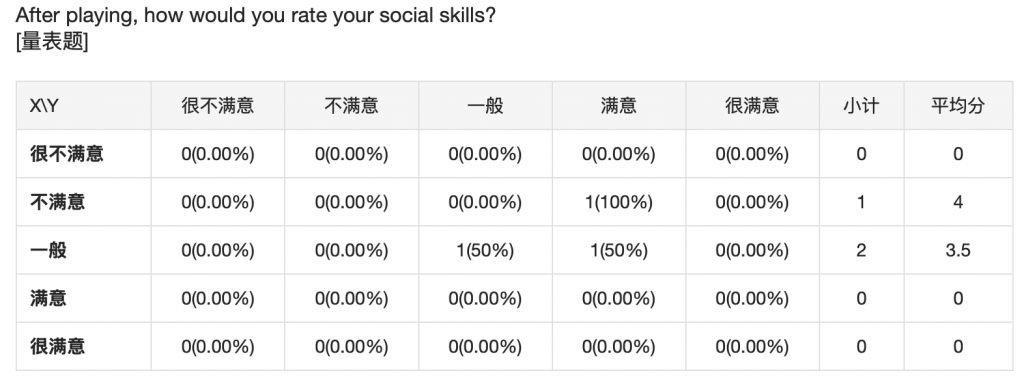
After participating in the activity, most people’s social skills improved.
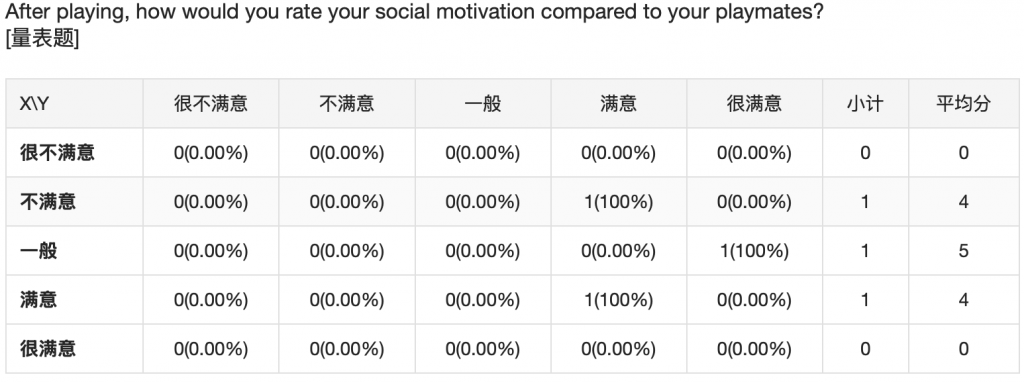
After playing, most people become more socially inclined.
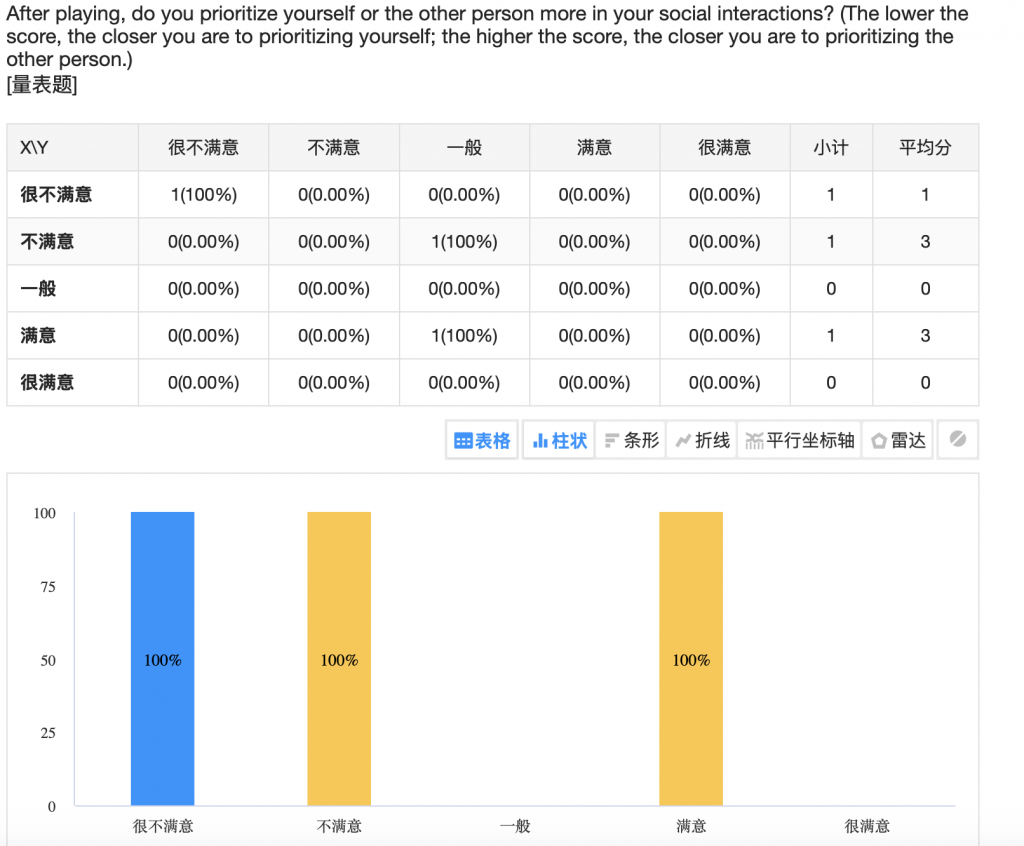
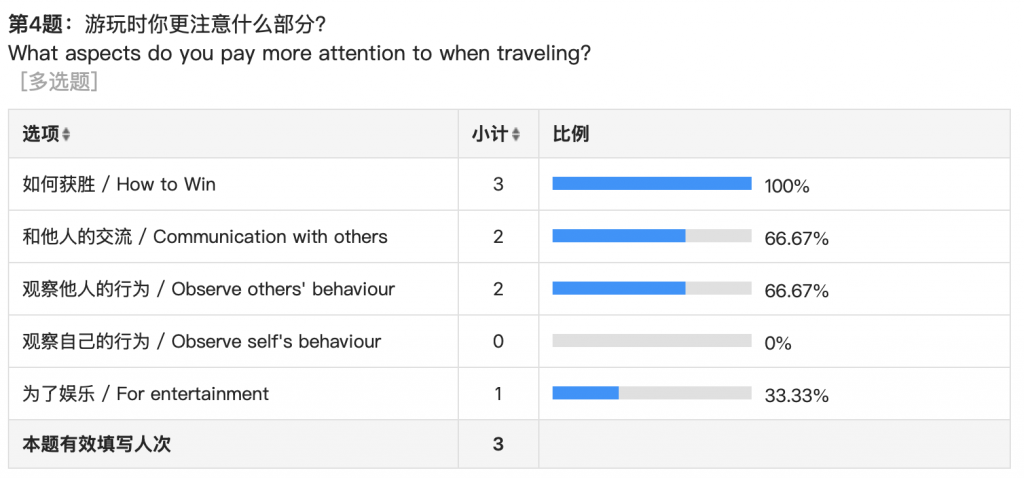
After the playing, most people shift from being extremely focused on themselves or others to striking a balance between the two.
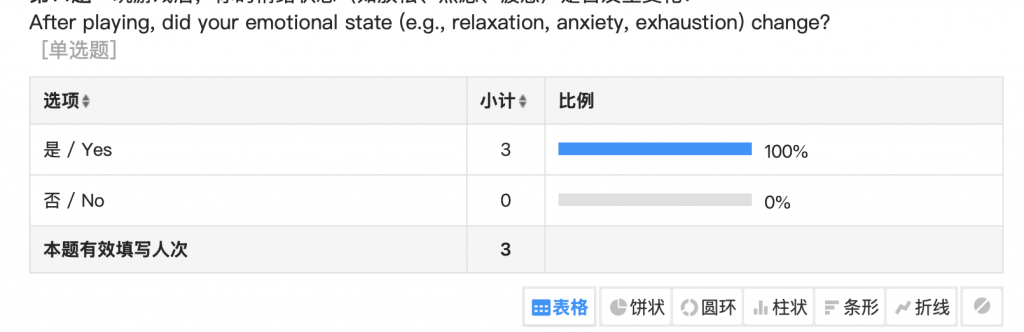
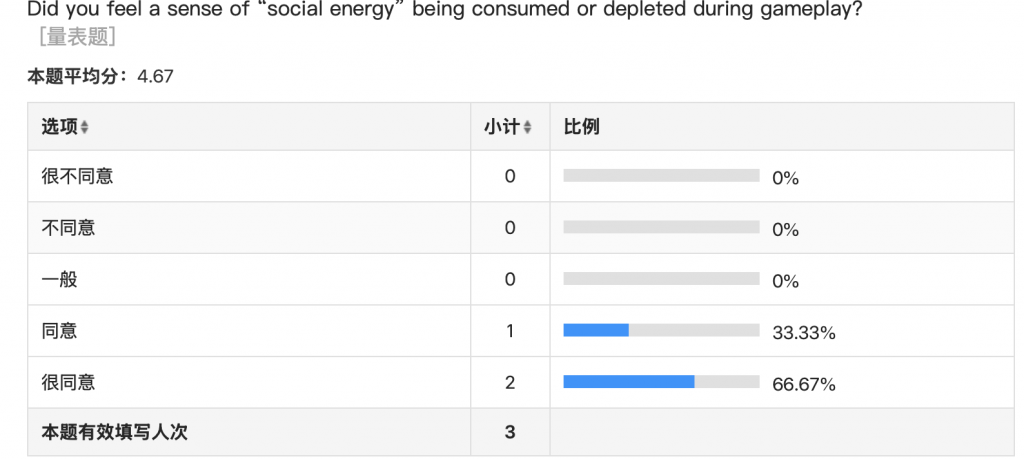
The game leaves participants feeling exhausted or lacking energy for everyday social interactions.
Most players have pointed out that the game presents a certain level of difficulty, and it is precisely this difficulty that simulates the challenges of everyday social interactions. This leaves them feeling exhausted. At the same time, they hope the game could offer more cards and incorporate more “rest” mechanics.
Nov.14th Addition:
Fifteen questionnaire samples have been received so far.
Below are the overall data:
| Indicator | Pre-game average | Post-game average | Trend |
| Social Motivation | 2.8 | 4.0 | High effectiveness |
| Social Skills | 2.8 | 3.6 | Moderate effectiveness |
| Willingness to Talk | 2.67 | 3.87 | High effectiveness |
| Realism | – | 3.53 | Moderate simulation |
| Social Pressure | – | 4.0 | High-level simulation |
| Energy Depletion | – | 4.2 | High-level simulation |
| Emotional Shift | – | 80% Yes | High-level simulation |
Based on the current data, both measures in this study have been successfully achieved.
Answers to Q16 and Q17 are as follows:
Q16:
- I felt very tired, yet it also seemed that these people were not impossible to communicate with.
- I felt a significant depletion of my energy after playing, and the fatigue was very real.
- It was mentally exhausting. Upon reflection, the model aligns closely with real social scenarios—needing to juggle many aspects—which makes one realize how tiring social life is. It feels more relaxing to play with familiar friends.
- Extremely tiring. It feels like I need to take care of myself while also taking care of others, constantly weighing things up.
- It did help deepen my connection with my colleague.
- It felt like experiencing real social interaction—immersive, but a bit exhausting.
- I felt a strong pressure to look after the people around me.
- It gave me a sense of workplace competition, and I noticed different sides of my colleagues.
- I realized that I subconsciously started considering others more. It also feels like a good icebreaker game.
- It was interesting; I played it with my roommates.
- I realized that I usually care too much about others. So this time, I focused on finding ways to win.
- It felt okay, though I didn’t fully understand how to play.
- I heard the game could help reflect on one’s social behavior. After playing, I did notice some shortcomings in my own interpersonal patterns.
- I felt anxious when I saw my numbers dropping. The game also encouraged some communication with my colleagues, and I normally dislike talking to them.
- It was interesting. I usually care a lot about my friends’ thoughts, but after the game I felt like I wanted to care a bit more about myself.
Q17:
- Cooperation between players felt realistic. I hope the event cards can be more diverse.
- The requirement to spend personal energy on tasks felt very true to life, and the resulting exhaustion was realistic. It would be better if a rest mechanism or some replenishment could be added.
- The emotional, networking, and energy systems were highly realistic. Once familiar with the rules, the system became quite interesting. Suggestions: (1) introduce Monopoly-like randomness or dice throwing to add complexity and agency; (2) fix or redesign the turn order to avoid early disadvantages; (3) if many players participate, add a private-chat mechanism.
- The randomness of drawing cards feels realistic—life is also full of uncertainty. Some tasks could be made simpler.
- Overall fine, but I hope more cooperative mechanisms can be added.
- The energy-depletion system is very realistic, just like in daily life. I hope the events become more diverse.
- Playing with family requires constant attention to everyone, which feels real. I hope there can be a buffer or rest round.
- I hope the workplace-related events can be separated into a dedicated module.
- I hope there are more cooperative projects.
- I hope some of the event cards can be more intense or stimulating.
- I hope there can be a set of purely family-based events and tasks, and additional systems can be added.
- It might be better if everyone votes on whether to join an event. I also hope for more conflict-based events; the game feels a bit plain right now.
- The combination of cooperation and confrontation feels realistic. I hope there is a debriefing or reflection session afterward.
- I hope for richer card content.
- I hope the cards can have more depth, with more narrative or descriptive text to enhance immersion.
Based on open-ended feedback from the third round of testing, participants commonly experienced emotions such as “exhaustion, tension, and anxiety” during gameplay. The stress induced by energy depletion closely mirrors real-life social scenarios, demonstrating Social Tower’s strong immersive quality in simulating the emotional burden and resource trade-offs inherent in authentic social interactions. Simultaneously, players gradually became aware of their own social patterns during decision-making and interactions—such as excessive accommodation, competitive tendencies, avoidance of communication, or hyper-focus on others—indicating the game triggered short-term self-reflection and behavioral awareness. Additionally, multiple participants mentioned seeing different sides of peers or family members through the game, suggesting the system also promotes interaction and communication. Regarding gameplay mechanics, feedback centered on four key needs: First, adding “recovery mechanisms” like rest or resupply to alleviate sustained stress. Second, diversifying events and deepening narratives to enhance immersion. Third, incorporating more complex social structures like cooperation, conflict, or voting to mirror real-world relationship networks. Fourth, introducing debriefing or reflection sessions to help players systematically understand their choices. Overall, this feedback indicates that Social Tower has achieved preliminary success in “simulating authentic social experiences” and “stimulating immediate reflection.” However, to foster longer-term improvements in social habits, further refinement and expansion are needed in positive reinforcement, narrative depth, interaction complexity, and reflection mechanisms.
Leave a Reply