
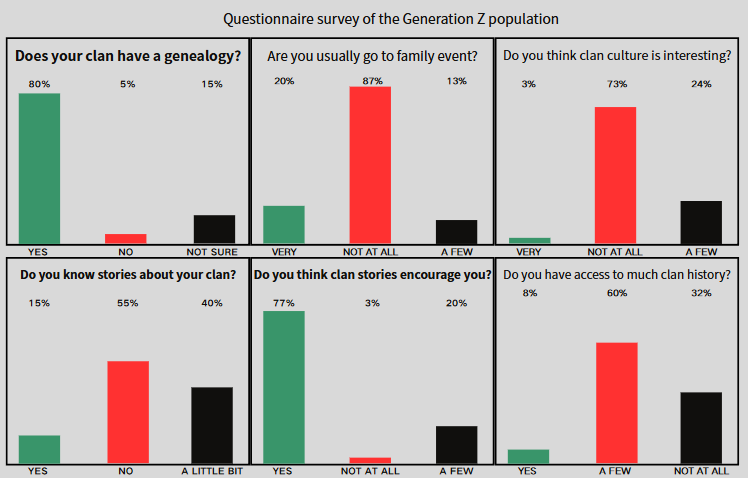
1. Through the survey, we know that: almost eighty percent of families have genealogical existence, which proves that the Chinese family identity itself is very strong;
2. Because of the development of atomized society and social media, more and more young people spend less time with their families and clans, and they think that traditional family rituals and family narratives are uninteresting, which is why the family identity is gradually disappearing among young people;
3. But family history and stories can unexpectedly inspire young people. When entering into in-depth communication with some of the interviewees, it was learned that famous figures in family history are those who are able to gain favorable comments from others in their lives and social life, which provides them with a sense of pride at the psychological level. These groups were generally favorable to the idea that family identity and family history need to be maintained. Another segment indicated that parents or grandparents add a lot of narrative aspects of family history to their childhood teachings, deifying ancestors and making subconscious beliefs that these stories have an inspirational effect. This segment of the population has a more neutral view of family. A small number of people with opposing views have an aversion to family because the family or family of origin casts a shadow over their childhood.
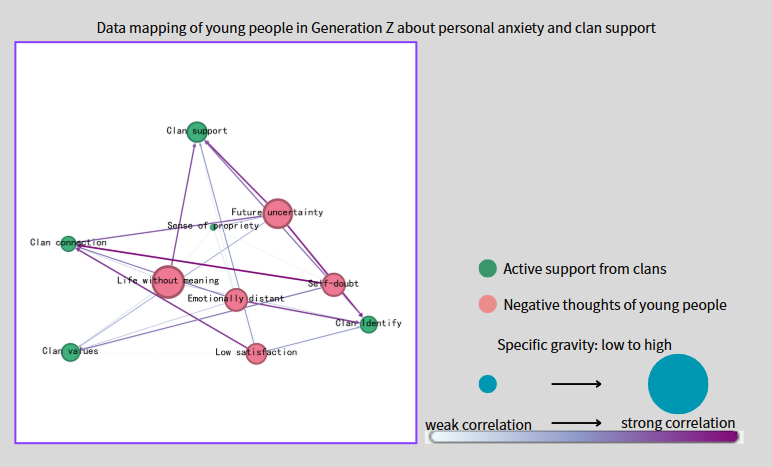
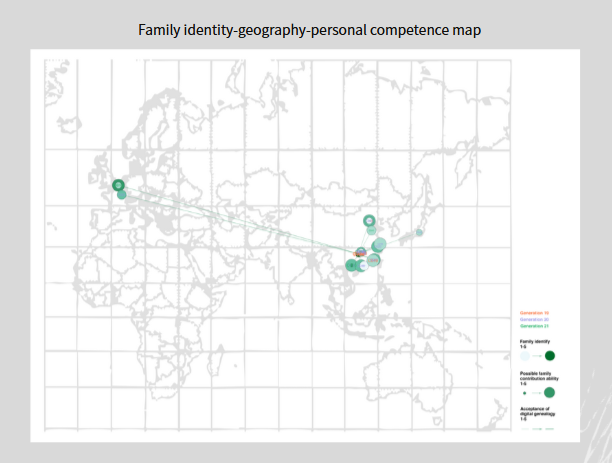
This is an in-depth interview with them, visualized based on Gephi’s sentiment analysis. This is because the people interviewed are all located in medium to large cities in China and are aged 22-30 years old, unmarried, without property or cars, and starting out in their careers. The icon sizes of the negative emotions represented by the purple color and the family support represented by the green color show that the atomized society (i.e., families that do not live with parents and children) makes it increasingly difficult to communicate and help family members in a timely manner, and without enough money to go for psychological interventions, many psychological problems cannot be solved well. As can be seen by the arrows, family interventions are negatively correlated with psychological problems. It shows that family intervention has a better performance in resolving psychological negativity.
The second chart summarizes my interviews with 50 members of my family. The conclusion is that family members who are not in their hometowns have the ability to help other family members, but do not have a sense of family identity and therefore do not connect with the family.
Combine this with the above analysis: is it difficult for people who are psychologically or physically disconnected from their families to access family information and family narratives, and thus difficult to generate the idea that I want to be able to connect with and ask for help from a member of my family, even if it’s not my parents?
Then, an entertaining and interactive approach can be used to build a sense of family identity to a certain extent by allowing young people to both relax and learn about family history or find family warmth in their free time after work or school.
This methodology was obtained following communication with Professor Zhan from the Center for Digital Humanities at Hunan University.
Leave a Reply