1.1. Abstract
The family is often romanticised as a ‘safe haven,’ but in reality, many psychological issues stem from the original family. So, does the ‘perfect family’ truly exist?
This artistic practice stems from my personal experiences and curiosity about family dynamics. I will use workshops, sculpture, and media to construct a fictional family history.
2.1. Observations
In this study, I interviewed ten young people aged 18-25 in southern China through a series of four workshops. I gained insights into different people’s ideas about family and the perfect family.
They mentioned images such as dining tables, windows, beds, and bookshelves, but the dining table was mentioned most frequently. These ‘memorable’ scenes are not perfect, but they are their most emotionally charged memories.
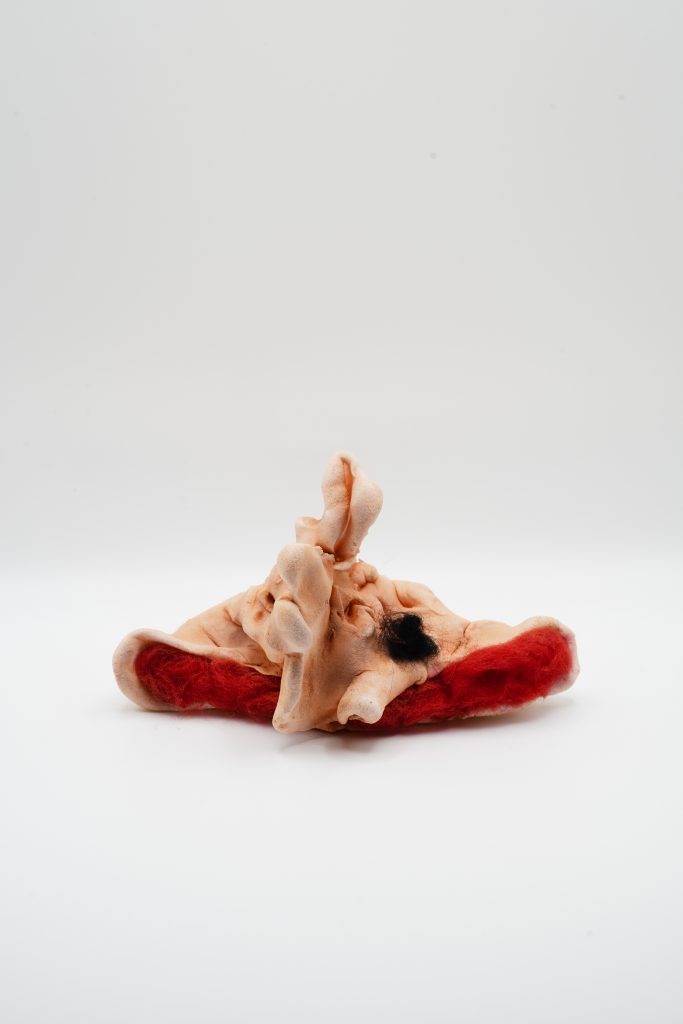
Some of the sculptures they created were inspired by interviews, some by their own memories of family, and others were more mechanical in nature (which helped them relax). It is evident that their emotions were influenced during the interviews, and the fingerprints, colours, and shapes on the sculptures all stem from their emotional triggers. (Especially when discussing the shortcomings of family and what constitutes a perfect family.)
2.2. Findings
The so-called ‘perfect family’ may not be a complete concept or truth, but rather a different experience for different people. It is an imagination that is constantly being recounted and reconstructed. But they all emphasise the importance of maintaining a proper balance between the individual and the family.
3.1. Methods and Experiments
3.1.1. Fictional Narrative
Overlay Participant A’s sculpture with Participant B’s interview to create a misalignment, revealing the uncertainty of memory.
In the exhibition and book production, all of the participants’ works and interviews were combined to create a fictional family history based on everyone’s real experiences. This allowed for a more unified collective imagination of the ‘perfect family.’
3.1.2. Predicting the psychology of readers/viewers
When viewing books and works, the audience or readers should adopt the perspective of family members rather than outsiders. While viewing, they may ponder the following questions: 1. The authenticity of all this; 2. Whether a perfect family truly exists; 3. What should my relationship with my family be like? What does my ideal family look like?
4.1. Meaning and value
I hope this project will encourage everyone to reflect on the following questions: 1. Is family defined by blood ties or by memories and emotions? 2. How do memories, narratives, and archives shape and change each person’s sense of belonging to a ‘family’? 3. Is the ‘perfect family’ an individual’s expectation of society?
This project aims to assist individuals who have developed psychological issues due to family-related challenges in re-evaluating their relationship with their family, thereby striving to overcome the emotional pain stemming from family-related experiences.
Leave a Reply