
- Chat Log
Me:
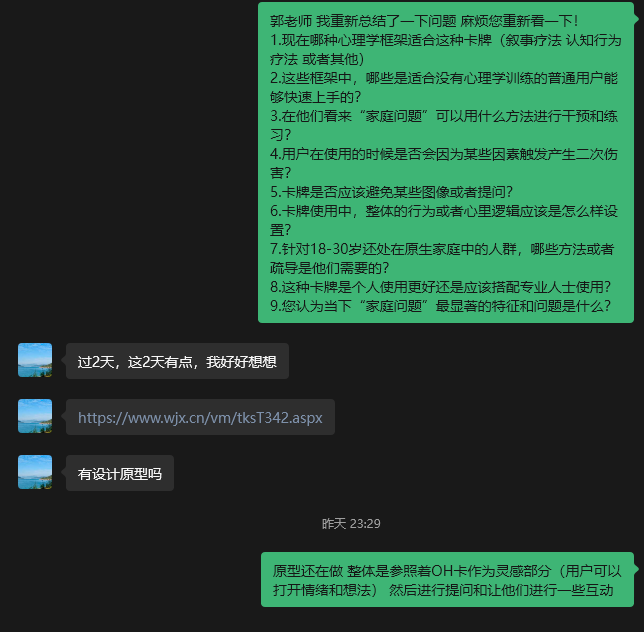
M. Guo, I’ve re-summarized the questions. Please review them again!
What do you consider the most prominent characteristics and issues of “family problems” today?
Which psychological framework is currently suitable for these cards (narrative therapy, cognitive behavioral therapy, or others)?
Among these frameworks, which ones are suitable for ordinary users without psychological training to quickly get started?
From their perspective, what methods can be used to intervene and practice with “family issues”?
Could certain factors trigger secondary harm for users during usage?
Should the cards avoid certain images or questions?
What should the overall behavioral or psychological logic be when using the cards?
For individuals aged 18-30 still living with their original families, what methods or guidance do they need?
Is this card deck better for personal use or should it be used with a professional?
Mr. Guo:
Give me a couple of days. I need to think this through carefully.
Have you designed prototypes for your cards?

Me:
The prototype is still in development. The overall design draws inspiration from OH Cards (where users can express emotions and thoughts), then prompts questions and encourages interaction.
Mr. Guo:
OK.
Me:
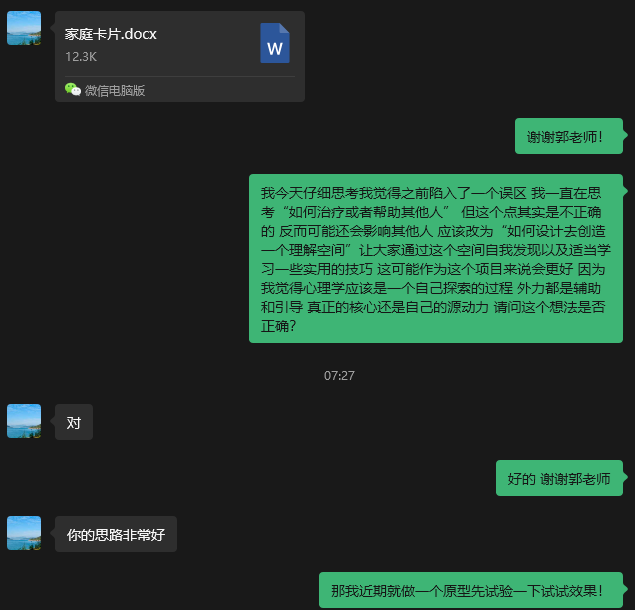
Today, after careful reflection, I realized I had fallen into a misconception. I had been fixated on “how to treat or help others.” But this approach is fundamentally flawed—it might even hinder others. Instead, we should focus on “how to design spaces for understanding” where people can discover themselves and learn practical skills. This might be a better direction for this project, as I believe psychology should be a journey of self-exploration. External forces serve only as guides and catalysts; the true core lies in one’s own intrinsic motivation. Is this perspective correct?
Mr. Guo:
Your approach is spot on.
2. Document
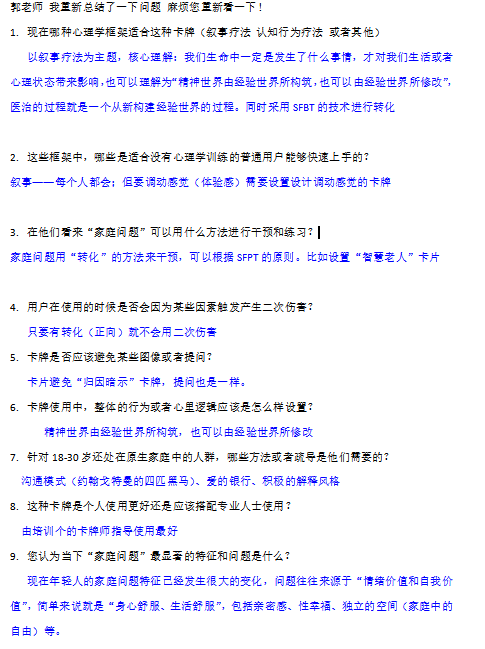
Q1:Which psychological framework is most suitable for this card set (narrative therapy, cognitive behavioral therapy, or others)?
A1:Centered on narrative therapy, the core understanding is: events in our lives inevitably shape our experiences and psychological states. This can also be interpreted as “our mental world is constructed by our experiential world and can be modified by it.” The healing process involves reconstructing this experiential world. Simultaneously, SFBT techniques are employed to facilitate transformation.
Q2: Among these frameworks, which ones are suitable for ordinary users without psychological training to quickly get started?
A2: Narrative—everyone can do it; but to evoke feelings (the experiential aspect), you need to set up cards designed to trigger those feelings.
Q3: What methods can be used to intervene and practice addressing “family issues” from their perspective?
A3: Family issues can be addressed through “transformation” interventions based on SFPT principles. For example, implementing “wise elder” cards.
Q4: Could users experience secondary harm due to certain factors during usage?
A4: As long as there is conversion (positive), secondary harm will not occur.
Q5: Should cards avoid certain images or questions?
A5: Cards should avoid “attribution-suggesting” imagery, and the same applies to questions.
Q6: When using cards, how should the overall behavioral or psychological logic be designed?
A6: The spiritual world is constructed by the experiential world and can also be modified by it.
Q7: For individuals aged 18-30 who still live with their parents, what methods or guidance do they need?
A7: Communication patterns (John Gottman’s Four Horsemen), the Love Bank, and a positive interpretation style.
Q8: Is this card deck best used by individuals or should it be used with a professional?
A8: It’s best used with guidance from a trained card practitioner.
Q9: What do you consider to be the most prominent characteristics and issues of “family problems” today?
A9: The nature of family issues among young people today has undergone significant changes. Problems often stem from “emotional fulfillment and self-worth,” which simply put, means “feeling comfortable physically and mentally, and enjoying a comfortable life.” This includes intimacy, sexual satisfaction, and having independent space (freedom within the family).
3. Analysis & Summary
SFBT Solution Focused Brief Therapy A solution-focused psychological approach that avoids exploring the causes of problems, instead concentrating on “exceptions” (moments when the problem did not occur) and “resources.” It encourages individuals to identify their existing strengths.
Narrative Therapy Proposed by Michael White and David Epston. The core idea is that we are constituted by “stories,” and psychological distress often stems from being “bound by a single narrative.” Healing involves “rewriting the story,” enabling individuals to redefine their personal experiences.
Attribution Implication Do not imply the cause of the user’s problem. Statements like “Are your parents controlling you?” can trigger psychological defenses.
Smart Senior Card Derived from Jungian psychology’s archetypes, symbolizing guidance and wisdom. Design several “Perspective Cards” to help users think beyond their current viewpoint, such as: “If you were an observer, what advice would you give your present self?”
Communication Patterns (Gottman’s Four Horsemen) The four patterns of communication breakdown proposed by Gottman: criticism, contempt, defensiveness, and stonewalling.
Love Bank The Emotional Bank Account Theory—Every positive interaction is a “deposit,” while negative conflicts are “withdrawals.” Relationship breakdowns often stem from “overdrafts.”
Positive Interpretation Style Originating from positive psychology (Seligman), this refers to interpreting events through an optimistic lens when encountering problems.
1.Using Narrative Therapy as the primary framework, combined with the positive transformation approach of Solution-Focused Brief Therapy (SFBT).
That is: the user first narrates (narrative) → then transforms (solution-focused).
2.Psychological Logic:
Card design should follow: Experience → Awareness → Transformation → Action.
3.Ethical Safety:
Avoid suggestive language (refrain from asking “why”; instead, ask ‘how’ and “how did you feel at the time?”).
Set up reflection cards and stop cards as “psychological buffers.”
4.Target Group Focus:
The core issue for the 18–30 age group is not “dysfunction,” but rather “emotional and value imbalance.”
Therefore, emphasis should be placed on strengthening two pathways: “self-understanding + communication skills development.”
4. Work Logic
User Question → Draw OH Image Card (Experience) → Narrate Story → Draw Star Chart Card (Action) → Execute Action / Reflect → Emotional Relief & Self-Understanding → Form New Experience
Leave a Reply