1.1.Abstract
After going through Dragon’s Den and consulting with experts, I believe the current card game has two issues: 1. The project’s core concept is unclear; 2. It lacks commercial viability or scalability. This is because: 1. There are already too many card games focused on family issues, and this project doesn’t offer sufficient appeal; 2. The scope could be expanded beyond family relationships to address how individuals navigate interpersonal dynamics (expert recommendation). Therefore, I designed a set of cards simulating social interactions.
2.1. Unit1-Unit4
Unit 1 — Research on Family and Individual Relationships
In Unit 1, my research began with “rethinking the relationship between the individual and the family.”
By revisiting family memories and interviewing members across generations, I explored how family structures shape an individual’s sense of identity and emotional belonging.
Influenced by theories such as Marianne Hirsch’s “Family Frames” and Benedict Anderson’s “Imagined Communities,”
I approached “family history” as a fictional narrative—both authentically existing and continually reconstructed through intergenerational storytelling.
To make this theme more experiential, Unit 1 explored “visualizing memory” through digital spaces and interactive games.
Using Gephi, I constructed a “Family Memory Network Diagram,” where nodes represent individuals and energy values denote emotional connections.
I also designed an early prototype: a small digital interactive space where viewers could click on different family members’ nodes to explore their presence.
The core question at this stage is: “When family history is digitized, can we reestablish an emotional connection with it?”
Unit 3 — Artistic Experiments in Personal and Family Relationships
Entering Unit 3, I refocused my research on artistic practices exploring family relationships and emotional expression.
During this phase, I completed several workshops and small-scale installations,
inviting participants aged 18–24 to create sculptures, share memories, and record voice messages around the theme of the “ideal family,”
to explore their understanding of family between reality and imagination.
The outcomes revealed a pervasive tension:
while family remains a symbol of emotional support,
participants also voiced pressures from expectations and control.
I transformed this material into sound archives and sculptural installations,
inviting viewers to experience the “emotional currents of familial relationships” within a space composed of fabric, light, shadow, and breath sounds.
Yet while organizing these outcomes, I began contemplating a broader question: “Beyond the family, how must individuals sustain energy and connection within society?”
Unit 4 — From Family Exploration Cards to Interpersonal Relationship Systems (Current Phase)
In the early stages of Unit 4, I continued the direction from Unit 3,
designing a card system centered on “exploring family emotions,”
named Family Exploration Cards.
This deck prompted participants to reflect on their relationships with family members through questions and tasks.
However, after testing, I found it too intimate and lacking in playability—
more akin to a psychological questionnaire than an interactive experience.
I then re-examined the relationship between game mechanics and emotions,
deciding to expand “family relationships” into a “social network system”
and rebuild the entire system around energy and relationship management.
Ultimately, I developed the current work—Relationship Management Card Game.
In this new version, players no longer explore only family but enter a socialized relationship cycle system.
Each player embodies a distinct young adult identity (student, new graduate, influencer, entrepreneur, freelancer, unemployed),
balancing their social network through events, opportunities, and choices within limited energy reserves.
The game uses “Energy” as its primary resource,
forcing players to constantly decide: whether to maintain relationships, expand connections, or sacrifice ties for growth.
It concretizes and gamifies “emotional labor,” offering an intuitive experience of the costs of social consumption.
Current Achievements
Completed entire rule system: Energy cap, relationship tiers, freeze mechanism, growth and reward cycle;
Designed complete card structures for six professions (Event Cards / Opportunity Cards / Special Cards / Relationship Event Cards);
Approximately 200 card contents written, covering social energy models for different professions;
Established numerical balance logic and relationship growth systems.
Conceptual Evolution
From Unit 1’s “Family Memory Re-narration,”
to Unit 3’s “Family Emotional Device,”
to Unit 4’s “Social Relationship Simulation Game,”
my research progressively shifted from the private individual level to the socio-psychological structural level.
3.1. Plan
October 2025: System and Text Finalization Complete integration of all card text and mechanics, conduct balance testing
November 2025: Visuals and Prototyping Design card art and color scheme; produce playable physical prototypes
December 2025: Playtesting and Exhibition Prep Conduct public playtesting in London to gather feedback; draft user experience report
January 2026: Presentation and Release Produce exhibition version of Relationship Management Card Game, showcasing rulebook and prototype demonstration
3.2. Introduction
Relationship Management Card Game is a strategy-based tabletop game that explores how young people balance emotional energy, social connections, and personal growth.
Set in a contemporary social context, the game simulates how individuals manage relationships under limited time and mental capacity — how they maintain, expand, or lose connections while navigating everyday life.
Each player takes on the role of a different young adult identity: a Student, Office Worker, Influencer, Entrepreneur, Freelancer, or Unemployed individual.
Each character has a unique energy limit, starting relationships, and passive ability, reflecting different life stages and social pressures.
Energy is the game’s core resource — every action, such as studying, working, resting, or maintaining a relationship, consumes energy.
When a player’s energy runs out, their relationships freeze or collapse, representing emotional burnout and social withdrawal.
The relationship system is structured into four tiers:
- High-level (Parents, Lover): deep emotional ties that provide long-term benefits but consume significant energy.
- Mid-level (Friends, Mentor, Leader, Partner): balanced connections that offer growth opportunities.
- Low-level (Classmates, Colleagues, Clients): practical relationships that occasionally restore small amounts of energy.
- Superficial (Fans, Online Friends): lightweight social ties that reduce action costs but bring minimal stability.
Across 12 rounds — symbolizing one year — players draw event, opportunity, and relationship cards each turn.
They must decide how to allocate their limited energy:
spend time working for a promotion, visit family, invest in a romantic relationship, or expand their network.
Each decision affects their “Relationship Value,” which determines who wins at the end of the cycle.
The game transforms abstract emotional experiences into a tangible, strategic system.
It visualizes how attention, care, and exhaustion circulate within modern social life —
inviting players to reflect on their own emotional labor, priorities, and sense of balance.
Ultimately, Relationship Management Card Game is more than entertainment;
it is a psychological mirror of contemporary social pressure —
a gentle reminder that in today’s world, every connection requires energy,
and every choice between people is also a choice about the self.
3.3.Current progress
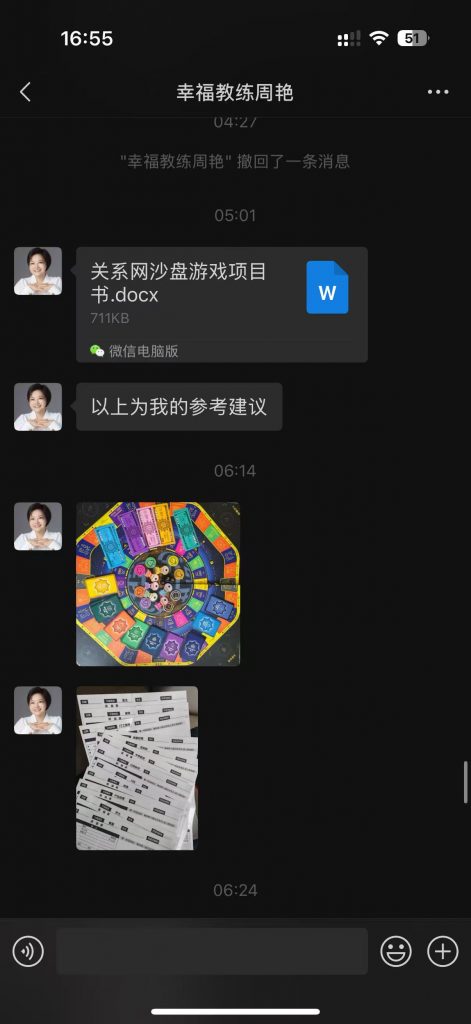
This table contains all the cards and game mechanics I have designed so far (Chinese version).
Leave a Reply